
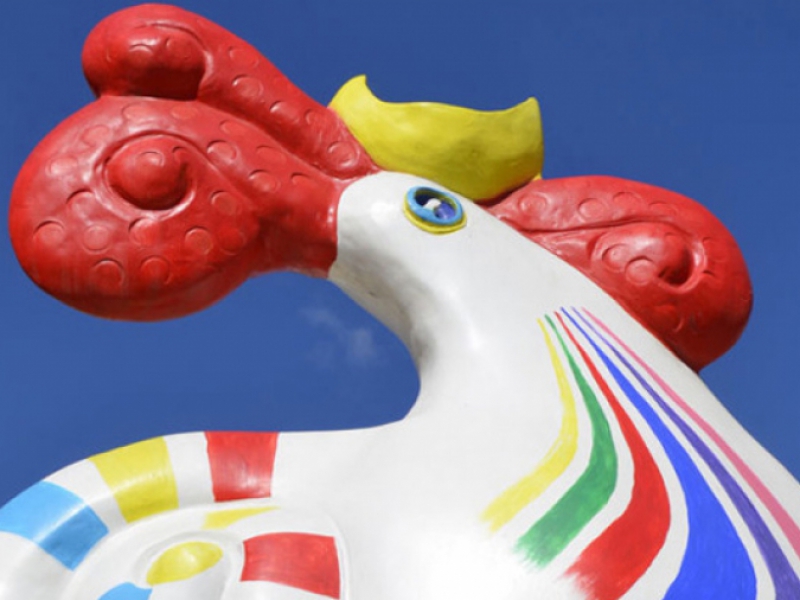
For those who come to Puglia it is a must to take a dip in the colorful Apulian tradition of terracotta whistles, small clay sound artifacts with a thousand shapes and bright colors.
Although they are widespread in different areas of the region, they find in the town of Rutigliano, about forty minutes from
"Il Vigneto Sole & Luna", their own "capital" where they show themselves in all their splendor.
In this area, the one between Grottaglie and Rutigliano, in fact, a clay called "red earth" is particularly widespread and local artifacts in 2003 obtained the recognition of the De.Co. (Municipal Designation of Origin) and have always been protagonists of the traditional Feast of Sant'Antonio Abate which is celebrated every year on January 17th.
On this occasion, the men of Rutigliano of all ages give their companions the typical whistle in the shape of a rooster as a symbol of love and good omen. Moreover, since 1989, the annual National Competition of the Terracotta Whistle "City of Rutigliano" is also combined with the famous fair.
Therefore, the oldest whistle found in the area dates back to the sixteenth century and depicts a cockerel, a symbol of virality and fertility; but if you take a tour in these villages of the Apulian hinterland, you can get lost in the numerous shops and be enchanted by the bright colors and the hundreds of different shapes they can take. But don't be fooled by the simplicity and genuineness of these small objects because behind each of them there is a complex manual processing that makes them unique in the world.
If you want to deepen the origins of this artisan tradition, you must necessarily make a trip to the Civic Museum of the Terracotta Whistle "Domenico Divella" where the visit winds through the exhibition of about 700 whistles distributed in five thematic areas.
To find out more, visit the website www.museodelfischietto.it

